

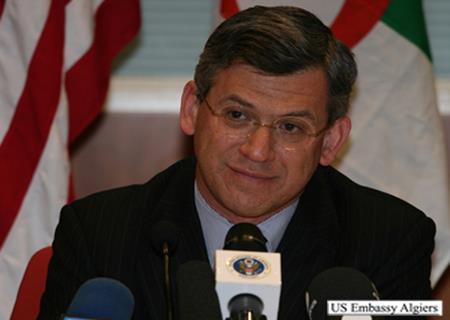
03 Jun Daniel Benjamin
Speaker: Daniel Benjamin
Director, John Sloan Dickey Center for International Understanding, Dartmouth College, Ambassador-at-Large and Coordinator for Counterterrorism, U.S. State Department (2009-2012)
Topics:
- Washington & The World: Who’s Leading Who?
- The Crisis in Ukraine: Russia — What’s Next?
- A Global Threat Assessment: Terrorism Trends of Today
- Mapping Risk: Navigating an Ever-Changing Global Landscape
- Ethics & Foreign Policy: What Will the Moral of Our Story Be?
Daniel Benjamin is one of America’s foremost authorities on counterterrorism, international security, and U.S. foreign policy. As the longest-serving Ambassador-at-Large and Coordinator for Counterterrorism at the U.S. State Department, he served as principal advisor to Secretary of State Hillary Clinton and played a central role in shaping America’s response to 21st-century security threats.
Three Decades at the Center of National Security
Benjamin’s career spans journalism, diplomacy, and academia at the highest levels. He began as a foreign correspondent, serving as Germany bureau chief for The Wall Street Journal and Germany correspondent for TIME. He then spent five years on the National Security Council staff under President Clinton, serving as a foreign policy speechwriter and director for transnational threats. His co-authored books The Age of Sacred Terror, which won the Council on Foreign Relations’ Arthur Ross Prize, and The Next Attack have been recognized among the most important works on modern terrorism.
A Scholar Who Connects Global Threats to Business Reality
Currently the Norman E. McCulloch Jr. Director of the John Sloan Dickey Center for International Understanding at Dartmouth College and President of the American Academy in Berlin, Benjamin holds degrees from Harvard, where he graduated magna cum laude, and Oxford, where he was a Marshall Scholar. His keynotes provide business leaders, students, and organizations with insider perspective on the evolving landscape of global terrorism, cybersecurity threats, geopolitical instability, and the forces reshaping international security.
Washington & The World: Who’s Leading Who?
Is the U.S. getting out of the business of leadership? Observers around the world are expressing criticism and concern at the Obama administration’s reluctance to bring all of America’s forces to bear against ISIS, its plans for a quick drawdown in Afghanistan and its posture vis-à-vis Russia after the annexation of Crimea. Asian nations are especially worried as they urge stronger U.S. engagement to help them stand up to the challenge of China, the world’s fastest rising power. A veteran of the Obama administration and longtime Washington insider, Ambassador Daniel Benjamin explains how the White House finds itself stretched between the demands of a war-weary populace and an array of global commitments that America alone can shoulder. He assesses whether the U.S. is getting the balance right and meeting the demands of the era, and he considers the possible consequences if it falls short.
The Crisis in Ukraine: Russia — What’s Next?
With his seizure of the Crimea, Russian President Vladimir Putin has instigated possibly the greatest international security crisis since the collapse of the Soviet Union in 1991. As the leader who brought this historic Russian territory back into the Russian state, Putin is enjoying a huge boost in domestic popularity.
For the United States and its European allies, Putin’s action has broken the post-Cold War taboo on changing borders by force. With Europe’s military forces weakened by years of defense cuts, and its economies reliant on Russian energy exports and deeply tied into Russian consumer markets, the appetite for tough measures is low though anxiety is high, especially among the EU’s newer eastern members. Drawing on his extensive White House and State Department experience, Ambassador Benjamin examines the wide-ranging consequences of this unheralded crisis, from their Eurasian core to the international efforts to curb the slaughter in Syria, which Putin has foiled, to curtailing Iran’s drive to acquire a nuclear capability.
A Global Threat Assessment: Terrorism Trends of Today
Almost 15 years after 9/11, the landscape of terrorism is changing rapidly. Though al Qaeda’s historic leadership in Pakistan has suffered profound damage and the threat of catastrophic attack has diminished, dangerous jihadist threats such as ISIS persist in Yemen and Iraq, and a plethora of new challenges have arisen, particularly across Africa. In the West, lone wolf operators who are hard to find and difficult to track add to the complexity of the picture.
As the State Department’s top counterterrorism official and as a high-level White House aide, Ambassador Daniel Benjamin takes the measure of the threats we face today, from bin Laden’s progeny to Iran’s role as the world’s foremost state sponsor of terrorism, and from the Islamic State to the emerging danger of cyberterrorism. He explains how the Arab Spring has radically altered the situation on the ground and how the conflict in Syria – and the sectarian strife behind it – could well spawn the next era of terror.
Mapping Risk: Navigating an Ever-Changing Global Landscape
In a short three years, international businesses have witnessed a redefinition of the security calculus for their foreign operations. In parts of the Middle East, the Arab Spring has opened up some societies, but swept away the ability of some states to provide a stable, safe environment. Elsewhere in the region, renewed repression has led to smoldering tensions or outright conflict. Terrorist groups are acting with greater impunity across Africa, while in countries such as Turkey, Brazil and Greece, social unrest has erupted, clouding these countries’ political and economic prospects. Daniel Benjamin served at the heart of the policy world at the State Department and the White House. With such experience, he provides audiences with a guide to the new global instability, identifying those developments that are passing trends and those that are reshaping the way governments and the global business community work.
Ethics & Foreign Policy: What Will the Moral of Our Story Be?
Every day, U.S. policymakers are confronted with a flood of news stories and intelligence on growing conflicts, mass atrocities and grave injustices. They also face the profoundly complex problem of reconciling their responsibilities to advance American interests and carefully manage American resources while upholding American values. In a democratic system, how should we weigh the requirements of moral principle against the preferences of the broader public? What role should concerns about political endurance and even survival play in these deliberations? Are there any moral imperatives in the conduct of statecraft?
Daniel Benjamin began working in the White House shortly after the Rwandan genocide and served in the 1990s through such events as the crises in the Balkans, the bombing of Sudan and Afghanistan and, in the first Obama term, played a central role in counterterrorism policymaking in such areas as Somalia, Iraq, Iran, Pakistan and Syria. In this talk, he reflects on the extraordinary challenges faced by those who must decide when the nation should act to prevent bloodshed, protect the helpless or redress inequity.
