

07 Apr Navigating the Future of AI and Tech:
4 Visionary Keynote Speakers You Should Know
Artificial Intelligence and emerging technologies are reshaping our world at an astonishing pace. From redefining customer experiences to transforming how we work, live, and connect, innovation is no longer a niche conversation—it’s central to every industry. For event organizers seeking to deliver value-packed sessions that combine foresight, relevance, and real-world application, it’s critical to choose keynote speakers who bring not just knowledge, but perspective, clarity, and charisma to the stage.
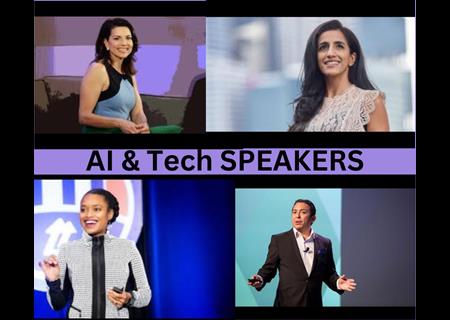
At Collaborative Agency Group, we work with a wide range of experts pushing the boundaries of what’s possible with technology. Here are four exceptional keynote speakers who are making waves in AI, digital transformation, and the human side of innovation.



Gina Bianchini – Community Architect in a Tech-Driven World
Gina Bianchini is a pioneering tech entrepreneur who has spent her career at the intersection of technology, community, and human behavior. As the founder and CEO of Mighty Networks, she empowers people and organizations to build niche social networks and online communities centered around shared interests and expertise. In an era where social platforms are becoming more fragmented and personalized, Bianchini offers a compelling message on how technology can be used to foster meaningful connections and engagement.
Her keynotes explore the evolution of digital communities, the future of creator-led platforms, and how businesses can use network effects to thrive in a rapidly changing digital landscape. Bianchini’s talks are not only thought-provoking—they’re grounded in practical insights that help leaders tap into the power of community to drive loyalty, learning, and innovation.
Organizations looking to future-proof their business models will find Gina’s message timely and actionable, especially as AI and automation continue to shift the way we gather, communicate, and collaborate.
Brian Solis – Human-Centered Innovation and the AI-Enhanced Future
Few voices in the digital space have been as influential as Brian Solis. A globally recognized futurist, digital anthropologist, and best-selling author, Solis is known for unpacking complex trends in a way that’s both accessible and inspiring. His work focuses on the intersection of disruptive technology and human experience—what he refers to as “the Novel Economy.”
Brian’s keynote presentations dive deep into how artificial intelligence, automation, and exponential technologies are reshaping customer expectations, employee experiences, and the very structure of modern organizations. With a career that has spanned decades of digital transformation, Solis brings historical context to emerging technologies, helping audiences see not just where we are now, but where we’re headed—and how to get there with intention.
Whether he’s speaking to business leaders about the power of digital empathy or guiding marketers through the evolution of customer journeys, Brian Solis bridges the gap between innovation and impact in a uniquely compelling way.
Crystal Washington – Tech Translator for the Real World
Crystal Washington has carved out a unique role as a “technology translator,” helping non-tech audiences understand and leverage cutting-edge tools to improve performance, build relationships, and future-proof their careers. As a technology strategist and futurist, Washington specializes in making complex tech topics relatable and immediately usable for professionals across industries.
Her keynotes tackle a wide array of trends including AI, automation, data privacy, and digital wellness—always with an eye toward helping audiences take action. Known for her energetic delivery and down-to-earth style, Crystal connects with diverse audiences, from corporate executives to front-line employees, making her an ideal speaker for events aiming to inspire broad organizational change.
What sets Washington apart is her ability to demystify technology without watering it down. She doesn’t just explain what’s coming—she helps you understand what it means, how it affects your work, and what you can do right now to stay ahead of the curve. Her focus on practical strategies, paired with a lively and engaging presence, ensures that her sessions resonate long after the event ends.
Ayesha Khanna – Architect of Smart Societies and Ethical AI
Ayesha Khanna is a globally recognized expert on artificial intelligence, smart cities, and the ethical deployment of emerging technologies. As the co-founder and CEO of ADDO AI, an AI advisory firm, Khanna has worked with leading organizations and governments to develop future-forward strategies that balance innovation with inclusivity and sustainability.
Her keynotes offer a powerful blend of technical insight and visionary thinking, focusing on topics like AI-driven urban planning, human-machine collaboration, and how to build ethical frameworks around increasingly autonomous systems. Khanna’s global perspective—shaped by her work in Asia, Europe, and the Middle East—adds depth and nuance to her insights, making her an especially valuable voice for organizations operating on an international scale.
Ayesha’s talks challenge assumptions while offering a hopeful view of what’s possible when innovation is guided by human values. Whether she’s speaking to policymakers, business executives, or educators, her message is clear: the future is being written now, and everyone has a role to play in shaping it.
Bringing the Right Voices to the Stage
Each of these speakers brings a unique lens to the conversation around AI and technology, whether it’s the transformative power of digital communities, the changing landscape of customer engagement, the democratization of innovation, or the ethical considerations surrounding artificial intelligence. What unites them is their commitment to helping audiences navigate change with confidence and purpose.
At Collaborative Agency Group, we believe that great events start with great conversations. And conversations about technology don’t have to be technical—they should be relevant, empowering, and deeply human. These four speakers exemplify that philosophy.
If you’re planning an event that tackles the future of work, digital transformation, or innovation in a rapidly evolving world, consider adding one of these forward-thinking voices to your lineup. Their insights won’t just inform—they’ll inspire.